


For Part I of Babes of Beijing – The Fruit Seller, click here.
* * *
The Photographer
He cycled past with a canvas bag slung over his shoulder, parked his bicycle, then headed straight for the table where several second-hand books had been laid out for sale that evening.
Andy from Blighty was moving to Berlin. And those books — a few works of English literature, a few by Peter Hessler — once trusty companions on a man’s daily commute, or trophy wives displayed on a bookshelf in his sitting room, had now been reduced to unwanted excess baggage.
I bought two myself and joined Andy and the rest with a bottle of cold Savannah cider. My eyes, though, were fixed on this man who had just arrived. I watched as he picked up a few books — ten yuan for a D. H. Lawrence. Essentially, a one-pound deal — then took a seat at our table, directly opposite me.
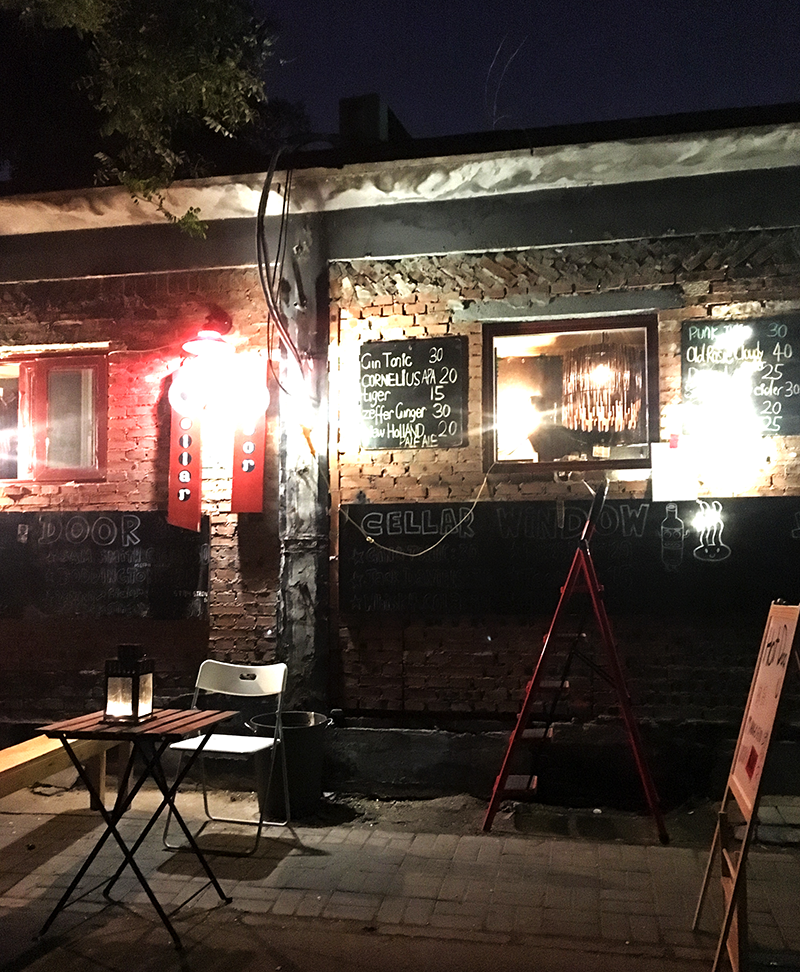
We were at a bar called Cellar Door. Literally a hole in the wall, with no door. One had to climb a short red ladder to order drinks from a window cut into a brick wall. Gimmick aside, it was a cracking little watering hole — low-key, easygoing, cheap drinks, stellar service. And the best part? The location.
Tucked away in a dusty, dimly lit hutong, Cellar Door was surrounded by rubble and ageing Beijingers living in siheyuan — dilapidated courtyard houses. This area is steeped in centuries of Chinese history, yet faces the insidious threat of the government’s short-sighted — and rather vitriolic — plans to “clean out” Beijing.
In recent years, countless historic homes and alleyways have been flattened, bulldozed, and razed to the ground to make way for new developments. Places like this will soon be gone. It is only a matter of time.
And as I dutifully joined the chorus of grassroots preservationists in criticising the government’s decisions, part of me couldn’t help but quietly rejoice in the fleeting existence of this place.
It will not be here forever.
And I had discovered an endangered species.

^ Cellar Door at FangJia Hutong, Beijing
I stumbled upon this bar one lonesome evening. It was the 22nd of July. A Saturday. My 25th birthday.
I had been told it was quite safe to walk through dark hutongs in the evening, as most Beijingers do. Convinced that this was simply a cultural norm, I did just that.
You see, there are two types of people when it comes to travelling — those who become irrationally frightened in a foreign land, turning cautious and, frankly, a little dull; and then there’s the death-or-glory type, who grow unusually bold because, well, YOLO — and who cares, nobody knows who I am.
Safe to say, it is the latter who are more susceptible to accidents, robberies, getting lost, and, at worst, having their bodies flown back home. Or, more often than not, stumbling upon a gem like this.
That evening marked my second visit to Cellar Door, and I had already made a few acquaintances — Andy, for instance, who was a regular. Our table was littered with empty beer bottles and cigarette packets. There were a few Brits, two Chinese, a Russian. And then there was Hannes.
And there was me.
My eyes followed him as he rose and made his way to the bar. He climbed the ladder, and the Chinese lady handed him a glass of white wine.
I wasn’t expecting that. No one drinks wine in a place like this.
Books. Wine. Tall. And a sharply chiselled face.
I knew, instantly, there was a story there.
Hannes is a Swedish photographer who has lived in Beijing for nine years — since 2009, the year after China hosted the Olympics.
The golden year of contemporary Chinese history, some would say — when the country spent £20 billion at 8 o’clock on 08/08/08 for a spectacular opening ceremony watched by over three billion people worldwide.
It was a show. A face-saving spectacle. A thunderous declaration that China had finally risen and caught up with the world’s superpowers.
Fair enough — the date and time made sense. The number eight resembles the pronunciation of fa, meaning wealth and prosperity in Chinese, and is considered lucky. But spending £20 billion in the belief that it would bring fortune? That’s like shooting yourself in the head just to test whether your lawyer drafted a good will.
Politics aside, it was an extraordinary show — phenomenal, breathtaking fireworks, and performances executed with military precision. At that moment, I too might have been tempted to move to Beijing.
I imagine that was part of Hannes’s reason.
While the group drank and drifted through conversations I barely registered, I remained fixated on him. Given how tightly we were seated around that tiny round table, I couldn’t speak to him alone.
But I waited.
You know that feeling — when you spot a subjectively attractive stranger and feel an instant pull, despite not having exchanged a single word? The kind where, the moment the seat beside him frees up, you’re already planning your move.
Well — gotta do what doers do.
When the chair emptied, I moved without hesitation.
We said hello. And what followed was a stream of consciousness — photography, travel, art, his music writing, my travel writing, Beijing, its people, life in the city. Everything. Nothing.
Every now and then, our conversation would be interrupted as he whipped out his film camera to capture passers-by — walkers, cyclists, motorcyclists. The flash startled a few. One man even shouted at him. He didn’t care. We laughed, and carried on.
I told him I had always wanted to experience living in a hutong with a local family. He said he had done exactly that for a year.
I asked him where the most romantic place in Beijing was.
“Nowhere,” he said. “Because romantic places just appear.”
One day, you wake up questioning why you moved to a smoggy, chaotic city like this. The next, you’re walking down a buzzing street, convinced it was the best decision you’ve ever made.
A love-hate relationship.
And that, he said, is romantic.
My attraction to him tripled.
At the end of the evening, he mentioned he was getting a taxi home and offered to walk me out of the quiet, dark hutong.
Cheeky bastard, I thought. What about your bike?
“Let’s do that,” I said.
He obliged.
We added each other on WeChat. The flirting and banter continued. I was too tired to recall the details — but I remember feeling happy. Slightly giddy.
Still, none of that quite mattered. Hannes was a man of action. Always scanning for the next frame — or rather, the imperfect moments that made his work so compelling.
Sweaty cooks taking cigarette breaks outside lamb skewer stalls — snapped. A topless man glaring suspiciously from a rundown electrical shop — snapped. Towering piles of recyclable waste dumped along the street — snapped. Me, approaching a burly man to ask for a photograph with his “Beijing belly” — snapped, and snapped again.
Moments like these are hard to forget.
We reached the entrance of my hotel. I turned towards him.
That awkward pause — where everything suddenly halts, and neither of you quite knows what to do next.
We shared an even more awkward hug and said our goodbyes, both fully aware that our paths were unlikely to cross again.
It has now been three and a half months since the night I met Hannes.
A week ago, I messaged him on WeChat, out of the blue. I asked if I could write about him — and, in doing so, sought his consent. I don’t like changing names or using pseudonyms in my writing.
He said he would be flattered. Asked me a few questions in return. But he didn’t sound entirely certain.
I told him, honestly, about my infatuation — and sent him a link to my blog.
To this day, he hasn’t replied.
Perhaps he thought I wasn’t serious. After all, what is there to write about a stranger you’ve only known for a few hours?
Or perhaps he assumed that, by not responding, I would lose interest — and forget about him entirely.
Hannes clearly doesn’t know what I’m capable of.
With love x